The Mid-Year Bookkeeping Cleanup Guide
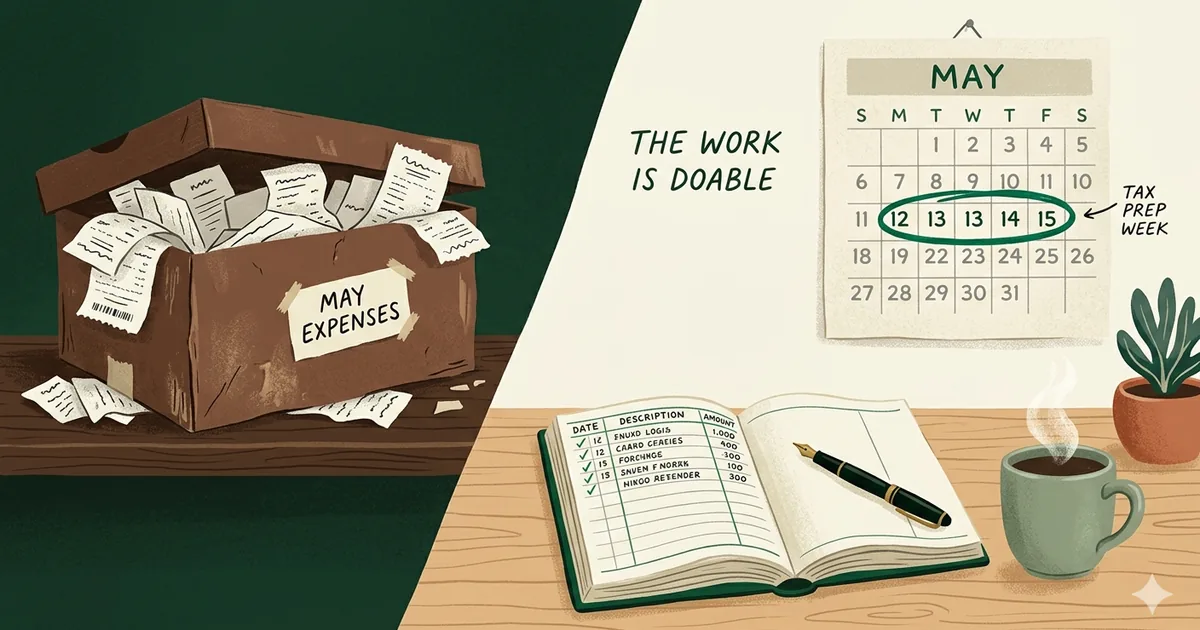
I see this every May. The owner-operator who got through April with their hair on fire, paid the CPA, swore they’d be ready next year, and woke up on May 1 with the same shoebox of receipts and a bookkeeping file that hasn’t been reconciled since February. Sound familiar? You’re not behind because you’re bad at this. You’re behind because the first four months of the year are when small businesses sell, and selling pays better than reconciling.
A shortcut for Day 1. simpleWhirks Books gives you a checkbook-style register on top of a real double-entry ledger, so the cleanup sequence below still applies, but the UI matches how owner-operators actually track money: in, out, running balance. Start free → (14 days, no credit card.)
What does “behind on the books” actually mean?
“Behind on the books” almost always means one of three specific things, not all of them. The first is unreconciled bank and credit card accounts — your accounting software shows a balance that doesn’t match your statement. The second is uncategorized transactions — money moved, but it’s sitting in “Ask My Accountant” or waiting for someone to decide what it was. The third is missing source documents — invoices, receipts, mileage logs, W-9s — that the IRS expects you to have if anyone asks.
Most people who say they’re behind have all three at once, and the reason they feel paralyzed is they’re trying to fix all three simultaneously. You don’t. You fix them in order, one bucket at a time.
Why is mid-year actually the right time to clean up?
Mid-year is right because the work is exactly half done and the next IRS deadline is three to six weeks away, not eleven months. April just demonstrated, in real dollars, what happens when your books aren’t current. Q2 estimated taxes are due June 15. Q3 is due September 15. If you wait until October, you’re cleaning up nine months instead of four, and you’re still behind on Q3.
The volume in May is also manageable. You have sixteen weeks to reconcile. By October it’s thirty-two weeks, and reconciliation gets non-linearly harder as time passes — broken matches stack up, the memory of “what was that $847 charge” fades, and receipts get lost.
What does a clean set of books actually contain?
A clean set of books has five things. (1) Bank and credit card accounts that reconcile to the statement as of the most recent month-end. (2) A current accounts receivable list — who owes you, how much, how long it’s been outstanding. (3) A current accounts payable list — who you owe, the same way. (4) A profit and loss report from January 1 through the most recent month-end where every line item rolls up into a tax return category you recognize. (5) A balance sheet that ties out — cash matches the bank, AR matches the customer list, AP matches the vendor list, and equity moves only by net income and owner draws.
If you have all five, your books are current. If you’re missing any, that’s the cleanup.
How long will mid-year cleanup actually take?
For a typical home-based or small-service business with one bank account, one credit card, and revenue under $250,000 annualized, plan on five working days — two to four hours per day, not eight. That’s the math behind the sequence below. Multiple cards, multiple bank accounts, payroll, or inventory each add a day. If you’re more than a year behind, this isn’t a five-day project anymore — there’s a separate question on what to do about that further down.
The two things that make people overrun the estimate are (a) trying to perfect months one through three before moving on, and (b) trying to learn new accounting software at the same time they’re cleaning up. Don’t do either. Get the data current first, optimize second.
How do you do the 5-day mid-year cleanup?
The five-day cleanup runs in this order: reconcile cash, clean the customer side, clean the vendor side, categorize what’s left, and run the reports. Each day builds on the previous one — skipping ahead breaks the next step.
Day 1: How do you reconcile your bank and credit card accounts?
You reconcile by pulling each statement and matching every transaction in your accounting software against it, in date order, from January 1 through the most recent month-end. Most cloud platforms have a side-by-side reconciliation screen. Check off matches. Flag mismatches. At month-end, your software’s ending balance should equal the statement balance — if it doesn’t, and you know your beginning balances are correct, the difference is either a missing transaction, a duplicated transaction, or a transaction with the wrong amount. Those are the only three options.
Do every account: bank, credit card, PayPal, Stripe, Square. If you have a personal credit card with mixed business charges, this is the day you separate them. Cash is the most important account on your books — every transaction either increases it or decreases it — so once cash reconciles, everything else flows from there.
Day 2: How do you clean up your customer and accounts receivable side?
Run an open-invoice or accounts receivable aging report and reconcile it against what you actually believe customers owe you. The report will surface three things to fix: invoices paid but never marked paid, invoices for customers you no longer work with that should be written off, and invoices that are real, overdue, and need a follow-up call this week.
While you’re in there, get your customer list consistent. One customer should be one record, not three with slightly different spellings. Capitalization the same way every time. Phone numbers and addresses formatted the same way. Unglamorous, and it pays off the next time you run a report.
Day 3: How do you clean up your vendor and accounts payable side?
Run an open-bill or accounts payable aging report and do the same exercise in reverse. Bills paid but never marked paid. Bills entered twice. Vendors set up two or three times under slightly different names — “Awesome Consulting LLC” and “Awesome Consulting L.L.C.” are not the same record in your software, even though they’re the same company, and that’s how duplicate payments happen. Many vendors can provide you with a statement showing your outstanding balance, which you can compare to your records.
Pull a W-9 from any vendor you’ve paid more than $2,000 this year and don’t already have one for. You’ll need it in January for Form 1099-NEC reporting, and chasing W-9s in January is materially harder than chasing them in May. Pick a naming convention — all caps, no punctuation is the easiest — and apply it to every vendor record.
Day 4: How do you categorize what’s left?
Open your “Uncategorized Expense” or “Ask My Accountant” account and clear it. Every transaction needs to be posted to an account: advertising, car and truck, contract labor, insurance, office expense, supplies, utilities, and so on. If a transaction was personal and got run through the business by mistake, recategorize it as an owner draw — not as an expense.
The general rule from IRS Publication 535 is “ordinary and necessary” for your trade or business. One of the biggest mistakes I see home-based businesses make is mixing personal expense with business expenses.
Day 5: How do you check the work?
Run a profit and loss report year-to-date and a balance sheet as of the most recent month-end, and look at them. Do the numbers match your gut? If you remember a $12,000 month and the P&L shows $4,000, something’s wrong. If your cash on the balance sheet is wildly off from what’s in the bank, the reconciliation didn’t actually finish. If your AR or AP totals don’t equal the totals on the aging reports, something didn’t post.
This is the day people skip because the work feels done after Day 4. Don’t. Most of the cleanup I do for clients in July and August is fixing the things they could have caught on Day 5 in May.
What breaks first when small-business books go neglected?
Four things break first, in this rough order. Vendor records are the first to drift — the same vendor gets entered three different ways, and duplicate payments quietly happen. Personal-on-business charges are second — a Target run, a dinner that was actually a date, an Amazon order that was half office supplies and half kid stuff — and they survive through to the tax return if nobody’s catching them. Mileage logs are third — most people stop logging by April and then estimate in March of the following year, which is exactly the wrong order. 1099 backup is fourth — you paid a contractor $4,200 in cash app payments, you don’t have their W-9, and now you’re guessing on their address in January.
None of these are fatal alone. All four together are the difference between an hour with your CPA in March and a week.
How does cleanup connect to your Q2 estimated tax payment?
Your Q2 estimated tax payment is due June 15. Standard practice is to pay your estimate based on 100% of the prior year’s tax, but if the calculation is based on what you’ve earned year-to-date you can often save yourself some money. If your books aren’t current, the calculation is a guess. Guesses go one of two ways: you under-pay and owe an underpayment penalty in April, or you over-pay and you’ve handed the IRS an interest-free loan you’ll get back twelve months later. Neither one is the goal.
The 5-day cleanup gets you a current year-to-date P&L. From there, calculating Q2 is mechanical: estimate full-year net income, estimate full-year tax, divide by four, subtract what you paid in April. Q2 estimated taxes are due June 15, 2026. The point for now is that you can’t do that calculation honestly until the cleanup is done. The IRS publishes the rules in Form 1040-ES; they’re unforgiving if your numbers are made up.
Should you switch bookkeeping software while you clean up — or after?
After. Almost always after. Cleaning up your existing books is one project; migrating to a new platform is a different project. Doing both at once is how people end up six months later with two messy systems instead of one. The exception: if your current software is genuinely the reason you’re behind — if QuickBooks Online has been confusing you for two years and you avoid opening it — switching first might be the unlock and starting fresh might be easiest. For most owner-operators, the order is: clean up where you are, get a current set of books, then evaluate the platform. Migrating messy books gets you messy books in different software.
What if you’re more than a year behind on your books?
If you’re more than a year behind, this stops being a five-day project and becomes a triage. The honest answer: bring in help. A bookkeeper can typically catch up a year of a single-owner business in eight to fifteen hours, billed somewhere between $400 and $1,500 depending on volume. A CPA-led cleanup is more — usually $1,500 to $4,000 — but it includes the tax-return implications and any prior-year amendments.
The reason to bring in help past the one-year mark isn’t that you can’t do it yourself. It’s that the cost of doing it yourself — the calendar weeks of weeknights and weekends — usually exceeds the cost of paying someone. Owner-operators make money selling, not reconciling. Pay someone to catch you up to the most recent month-end, then run the 5-day cleanup yourself going forward to keep it current.
How do you keep this from happening again next year?
You set up a monthly reporting cadence and you do not skip it. Monthly reporting means: by the 10th of the following month, every account is reconciled, every transaction is categorized, and a P&L and balance sheet have been reviewed for anything that looks wrong. The first month takes three or four hours. The fifth month takes an hour. By month twelve it’s a thirty-minute exercise on the second Saturday of every month.
The owner-operators I see stay caught up are the ones who put it on the calendar as a recurring appointment with themselves and treat it like a customer meeting they can’t reschedule. The ones who fall behind do it “when they have time,” which means never. Pick a date. Defend it.
When should you bring in a CPA versus do it yourself?
Bring in a CPA when the question is about strategy, not bookkeeping. Reconciling your bank account is bookkeeping — you can do that. Choosing whether to elect S-corp status, deciding whether to depreciate or expense a $4,000 piece of equipment, evaluating whether your home office deduction will survive scrutiny — those are CPA questions, and they’re worth paying for because the cost of getting them wrong is several multiples of the fee.
The framework: bookkeeping is a process; taxes are a strategy. Process you can systemize. Strategy you should buy. For ongoing CPA-level support that isn’t priced like a Big Four engagement, a virtual CFO arrangement gets you the strategic conversations on a monthly retainer — that’s what I do at simpleWhirks — but the framework stands regardless of who you hire.
Read more from Garrett — bio, credentials, and other posts on his author page →.
Frequently asked questions
Defined Terms
- Reconciliation
- Matching every transaction in your accounting software against the corresponding bank or credit card statement, line by line, until your software's ending balance equals the statement balance to the penny.
- Chart of accounts
- The list of categories your software uses to organize transactions ("Office Supplies," "Contract Labor," "Vehicle Expense"). A good chart of accounts maps cleanly onto your tax return so your tax preparer's year-end handoff is straightforward.
- Accrual vs. cash basis
- Two ways to record income and expenses. Cash basis records when money moves; accrual records when the work is done or the obligation is incurred. Most home-based businesses use cash basis for tax purposes.
- Opening balance
- The starting figure for an account at the beginning of a reporting period. If you switch software mid-year, opening balances are the most common thing to get wrong, and they break every report downstream when you do.
- Schedule C
- Although small businesses can be taxed as S-Corps, C-Corps, or Partnerships, most sole proprietors and single-member LLCs use Schedule C to report business income and expenses on their personal return at year-end. Your tax preparer or CPA is the one who files it — what matters for your bookkeeping is that every category maps cleanly to a Schedule C line, so the handoff is clean and you're not re-categorizing in March.